Acoustical Society of America
ASA/EAA/DAGA '99 Meeting
Lay Language Papers


Reinhard Geisler
Thomas Kurz
Werner Lauterborn
Drittes Physikalisches Institut
Universität Göttingen
Bürgerstr. 42-44
D-37073 Göttingen, Germany
Popular version of paper 2pPAd6
Presented Tuesday afternoon, March 16, 1999
ASA/EAA/DAGA '99 Meeting, Berlin, Germany
Cavitation in liquids can occur, for example, in fast flows or strong
sound fields, when the ambient pressure falls below a certain value,
approximately given by the vapour pressure.
Bubbles are created, and grow by the underpressure.
Subsequently they show quite different behaviour depending on the
environment.
They may dissolve again, or grow until they break up into smaller
bubbles, or start to oscillate.
In a strong sound field, in particular, the bubbles can be excited to
such high-amplitude, nonlinear oscillations that they collapse in each
cycle to a tiny volume.
The strong compression of the bubble leads to a variety of effects:
the emission of shock waves into the liquid, catalysis of chemical
reactions, high temperatures and pressures within the bubble, and even
the emission of light.
The latter phenomenon, called sonoluminescence, has attracted
much scientific and public attention lately and spurred research in
the field.
 Cavitation is a scientific discipline with many facets.
The tiny bubbles display complicated and even chaotic dynamics when
driven by a sound field or when interacting with each other in bubble
clouds.
The processes in bubble collapse and the mechanism of light emission
are still not very well understood.
Thus bubbles provide ideal objects for basic research.
On the other hand, cavitation has many practical and applied aspects
with bearings on industrial applications, e.g.
Cavitation is a scientific discipline with many facets.
The tiny bubbles display complicated and even chaotic dynamics when
driven by a sound field or when interacting with each other in bubble
clouds.
The processes in bubble collapse and the mechanism of light emission
are still not very well understood.
Thus bubbles provide ideal objects for basic research.
On the other hand, cavitation has many practical and applied aspects
with bearings on industrial applications, e.g.
 A few years ago D. F. Gaitan
(in his Ph.D. work in Oxford/Mississippi under the supervision of
Prof. L. A. Crum, now Seattle)
developed a method to
trap a single sonoluminescing bubble within an acoustic standing wave
field.
With this "hydrogen atom of sonoluminescence" interactions
between bubbles are eliminated, and the undisturbed single-bubble
dynamics can be scrutinized.
Such a bubble trap is realized by taking advantage of a force already
investigated at the turn of the last century by C. A. and
V. Bjerknes.
The force on an object in a liquid depends on its volume and the
pressure gradient.
Normally this is only the well-known static buoyancy induced by
gravitation.
In the presence of a standing sound wave there will be an additional
gradient, which alternates with the frequency of the sound.
Since a small bubble oscillates in phase with the sound pressure -
small volume in the high pressure phase, large volume in the low
pressure phase - one direction of the resulting force will outweigh
the other (see illustration).
Hence, the time averaged force drives the bubble towards the antinode
of sound pressure and keeps it there.
A few years ago D. F. Gaitan
(in his Ph.D. work in Oxford/Mississippi under the supervision of
Prof. L. A. Crum, now Seattle)
developed a method to
trap a single sonoluminescing bubble within an acoustic standing wave
field.
With this "hydrogen atom of sonoluminescence" interactions
between bubbles are eliminated, and the undisturbed single-bubble
dynamics can be scrutinized.
Such a bubble trap is realized by taking advantage of a force already
investigated at the turn of the last century by C. A. and
V. Bjerknes.
The force on an object in a liquid depends on its volume and the
pressure gradient.
Normally this is only the well-known static buoyancy induced by
gravitation.
In the presence of a standing sound wave there will be an additional
gradient, which alternates with the frequency of the sound.
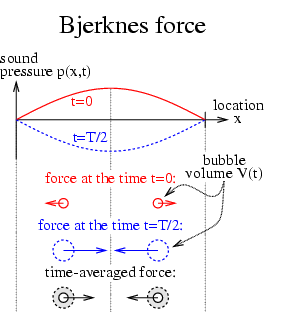
Since a small bubble oscillates in phase with the sound pressure -
small volume in the high pressure phase, large volume in the low
pressure phase - one direction of the resulting force will outweigh
the other (see illustration).
Hence, the time averaged force drives the bubble towards the antinode
of sound pressure and keeps it there.
 Provided that the sound pressure amplitude is sufficently large, the
Bjerknes force can easily compensate gravitation.
Thus an acoustic bubble trap simply consists of a standing sound wave
in a liquid inside a vessel.
The photo on the right shows a cubical bubble trap working with
ultrasound at a frequency of 23 kHz.
A single bubble is trapped in its center and illuminated by a laser
beam.
Provided that the sound pressure amplitude is sufficently large, the
Bjerknes force can easily compensate gravitation.
Thus an acoustic bubble trap simply consists of a standing sound wave
in a liquid inside a vessel.
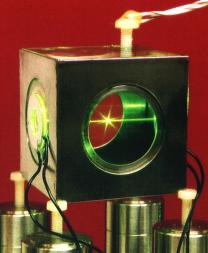
The photo on the right shows a cubical bubble trap working with
ultrasound at a frequency of 23 kHz.
A single bubble is trapped in its center and illuminated by a laser
beam.
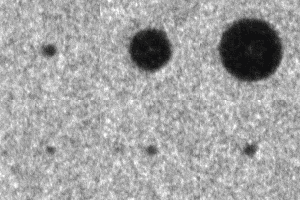
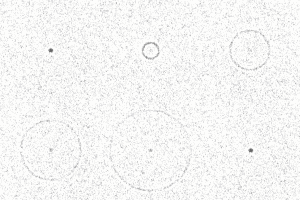
Sonoluminescing bubbles perform anharmonic oscillations, like the one
shown in the left film.
The bubble radius here is 55 micrometers at maximum.
Clearly visible is the strong bubble collapse:
it is held responsible for the emission of the sonoluminescence light
flash and the shock wave with every period of the sound field.
The right film shows such a shock wave propagating 800 micrometers in
about 0.38 microseconds (For a better demonstration this film is
repeated automatically).
 The main objective in design of bubble traps is to establish a good
resonance inside the vessel.
To control its quality there are several methods, employing
microphones or hydrophones.
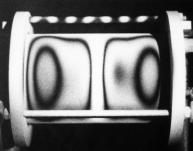
With holographic interferometry it is also possible to visualize
the modal structure of the vibrations at the surface of the vessel.
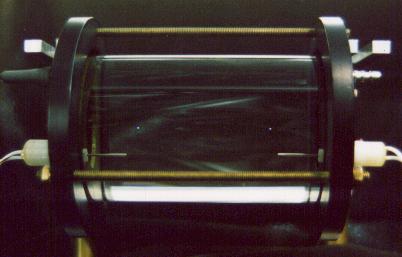
The photo on the left shows a hologramm of a cylindrical trap
vibrating in its first overtone, i.e. a mode with two antinodes of
pressure.
With this configuration two sonoluminescing bubbles can be trapped
(photo below).
Traps of this kind fill the gap between the study of a single bubble
and the study of multi-bubble systems.
In particular, by this device the effect of emitted shock waves on
other bubbles can be investigated.
The main objective in design of bubble traps is to establish a good
resonance inside the vessel.
To control its quality there are several methods, employing
microphones or hydrophones.
With holographic interferometry it is also possible to visualize
the modal structure of the vibrations at the surface of the vessel.
The photo on the left shows a hologramm of a cylindrical trap
vibrating in its first overtone, i.e. a mode with two antinodes of
pressure.
With this configuration two sonoluminescing bubbles can be trapped
(photo below).
Traps of this kind fill the gap between the study of a single bubble
and the study of multi-bubble systems.
In particular, by this device the effect of emitted shock waves on
other bubbles can be investigated.